

A few things before we dive in here:
- I am very proud of what we’ve built with Colette and think it is important that operators of restaurants help create the tools we’ll use going forward. I hope you will share this piece to help amplify.
- There is a piece in the Boston Globe that will come out over the next couple days that I am also proud of but, as of publishing this piece, deeply disagree with the headline- “The most crucial employee at this Boston restaurant isn’t human”. That is not true, even a little.
- The people who work there asses off everyday at Shy Bird, and any restaurant, dwarf any technologies impact including Colette. I regret if anything I said implied otherwise. Celina Colby wrote a great piece that is important but I worry will be overshadowed by the headline. I’ve asked to have the headline changed but I don’t expect that it will be.
- The implication of automation in restaurants is uncomfortable to sit with and the headline only reinforces this.
I go much deeper into that below and in the many pieces that preceded this one. I hope this article expresses my true feelings about the role AI can and should play in our industry.
On Monday, June 1, our Shift Lead line cook Samuel found me at Shy Bird South Boston and told me we were doing taco night tomorrow. He and a colleague had already made the tacos. He wanted me to try them. There was a shrimp taco and a birria taco with some killer dipping sauce from the braising liquid. I was excited. I was also worried.
It was an early summer Tuesday. No marketing had gone out. No one knew. And the thing I was most afraid of was that all of Samuel’s work, the tacos and the pride behind them, would land in a half-empty dining room on a night when no one was looking.
Before Colette, the AI platform we developed internally, I would have sent a series of emails and texts with a mix of images and attachments. The communication would have been cumbersome, fractured and likely ineffective. In this instance we used Colette to pull the team together fast in a channel, asynchronous but not disconnected. We communicated, collaborated and coordinated across functions in one place to cover social media planning, menu reviews, staff levels and training.
By 10pm Tuesday, both taco specials had sold out. 305 covers on the day. Net sales up 13.4% over the prior week.
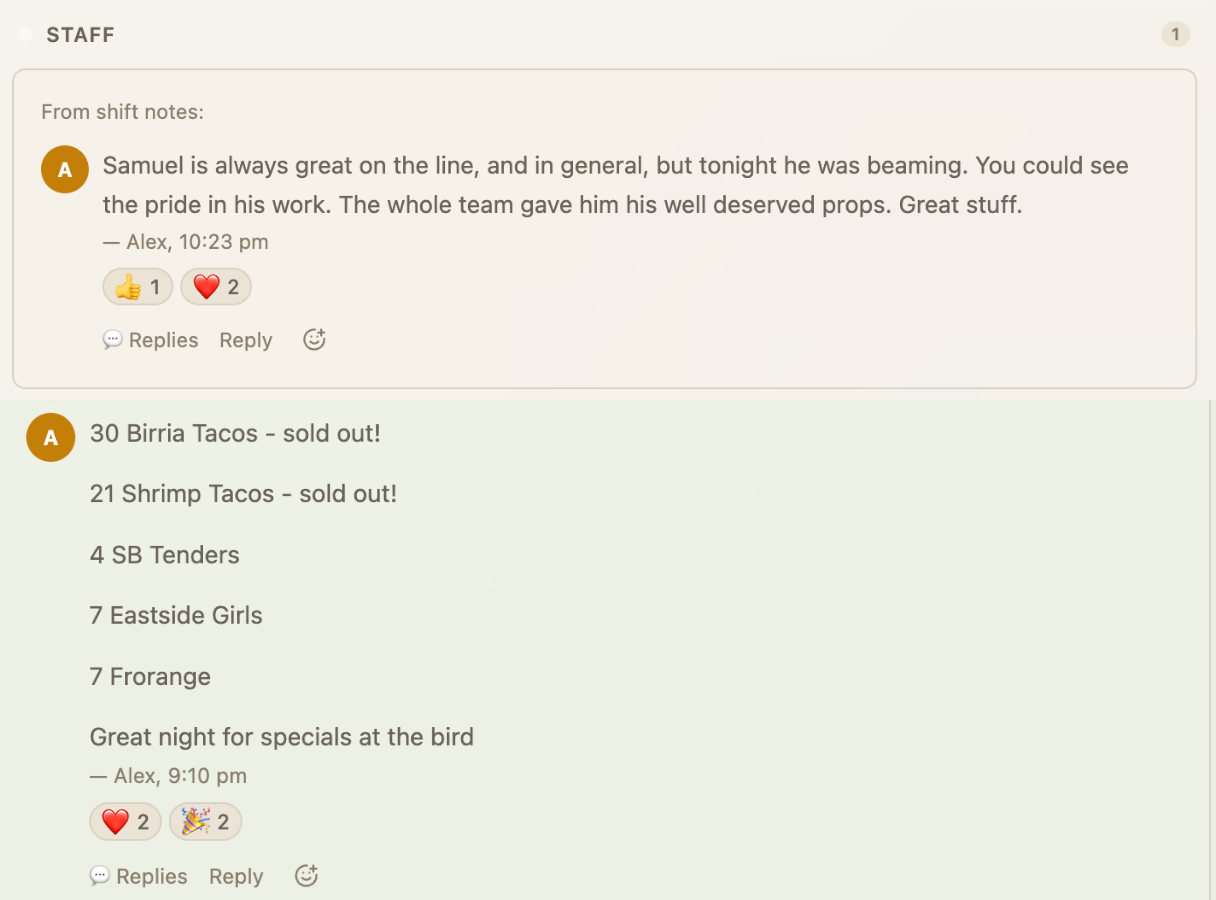
The General Manager wrote in the shift log which is also within Colette: “Samuel is always great on the line, and in general, but tonight he was beaming. You could see the pride in his work.”
This article, the 106th of this newsletter coming nearly 3 years into writing it, marks the official launch of Colette, a platform for communication, collaboration and automation for restaurants.
Restaurants employ roughly one in ten American workers. They are engines of mobility, where entrepreneurs from all walks of life build businesses, teenagers learn to work, dishwashers become cooks become owners. They are irreducibly physical, irreducibly social, and irreducibly about showing up for each other and guests. Restaurants are a team sport.
As AI reshapes the economy, restaurants will carry more weight as anchors of employment, community, and connection. The role restaurants play in how people eat, gather, and recognize one another is expanding. The restaurant industry has become our shared urban social infrastructure.
But today’s margins can’t support tomorrow’s role. The average independent restaurant runs on 3-5% net margins. The version of restaurants I’m describing, more indispensable, more human, more integral to how communities cohere, requires solving a profitability problem that’s always been there but feels particularly acute over the last decade.
That’s the problem Colette is built to solve using AI, the transformative technology of our time. Before I explain how, I want to address a part of what’s at stake if the collective we get this wrong.
Nicholas Carr spent two books tracing what happens when automation enters skilled human environments. In The Glass Cage, his central case is aviation. Autopilot has made modern flight extraordinarily safe. It’s also made pilots worse at the manual flying they need precisely when normal conditions fail. The skill simply atrophied. The cognitive work the tool eliminated wasn’t just friction. It was how the judgment was being built.
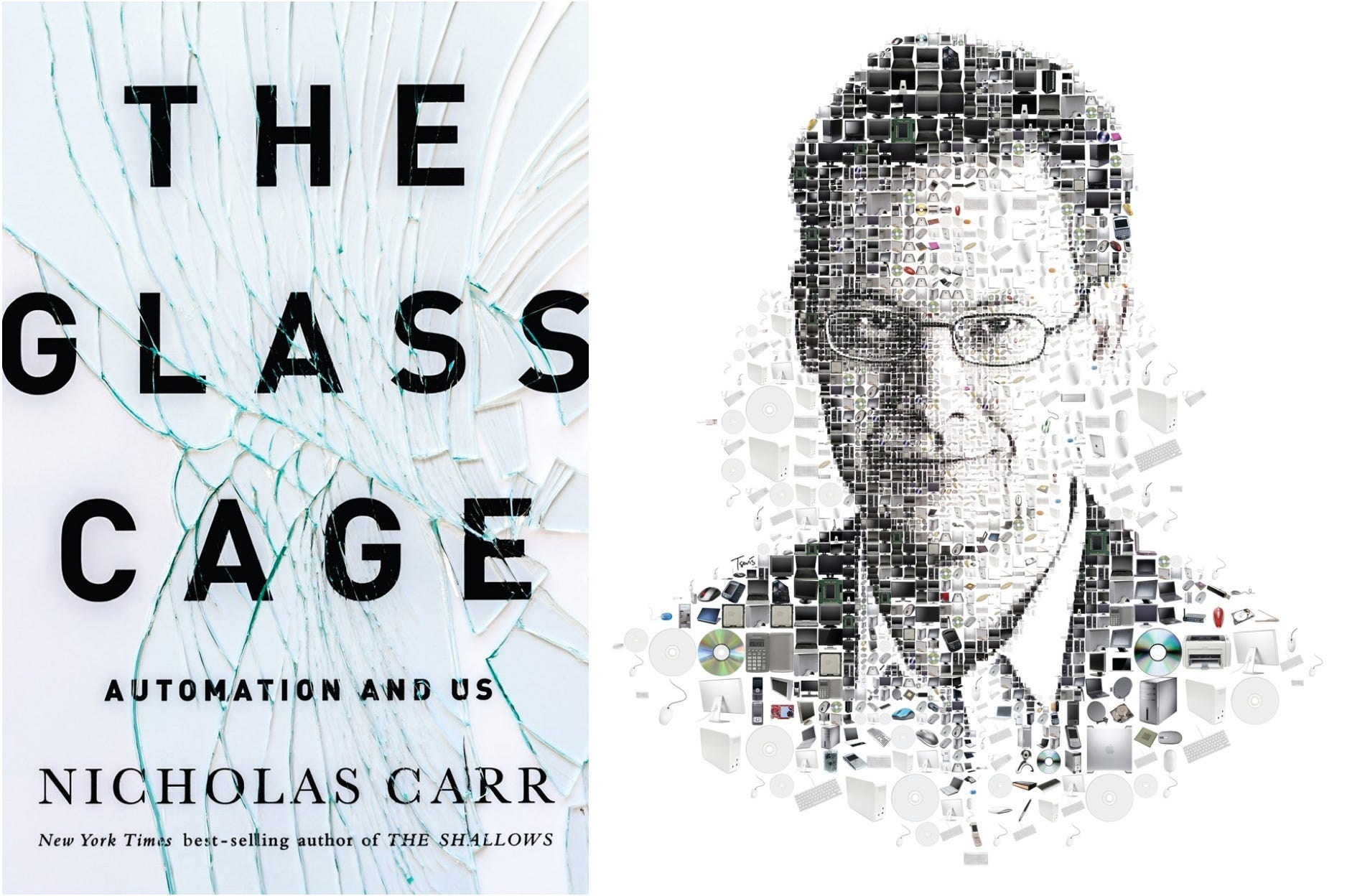
He finds the same pattern in architecture, medicine, navigation. The tools we use to think reshape how we think. The instrument leaves a mark on the hand that holds it.
I’ve seen the same thing happen with automation in restaurants. When OpenTable went to algorithmic table assignments, managers and hosts gradually deferred to the computer’s assignments. A second order effect here was disengagement and, over time, skill atrophy to the detriment of the employee and guest experience.
The implication of automation in restaurants is uncomfortable to sit with. The cognitive load of running this business, manually tracking food and labor, for example, holding the P&L in your head, isn’t just administrative burden. It’s also how operators build intuition. The GM who reconciles food cost every week isn’t just doing a chore. She’s building pattern recognition. She knows what a bad week looks like before she sees the number because the muscle memory has been developed through the sometimes monotonous data entry.
Automate that carelessly and you might get the hours back. You might also produce a generation of operators who can’t read their own business. Perhaps more concerning is the potential to automate away, intentionally or otherwise, the genuine human engagement required to create connection.
Our leadership at both Shy Bird and Colette worry this is the path that we are on. Optimization through automation without care for engagement amongst your team or with your guests. The distinction matters practically, because what you believe about restaurants determines whether you build tools that deepen the humans inside them or hollow them out.
Back to Tuesday night.
A loyal line cook wanting to present a dish of their own conception and making to guests is to be cherished and supported however we can. Cooks spend years executing someone else’s vision, invisibly. Samuel wanted to make something his, in front of people he respects, and find out if the room would show up for it. That ambition is the thing that technology should be in service of.
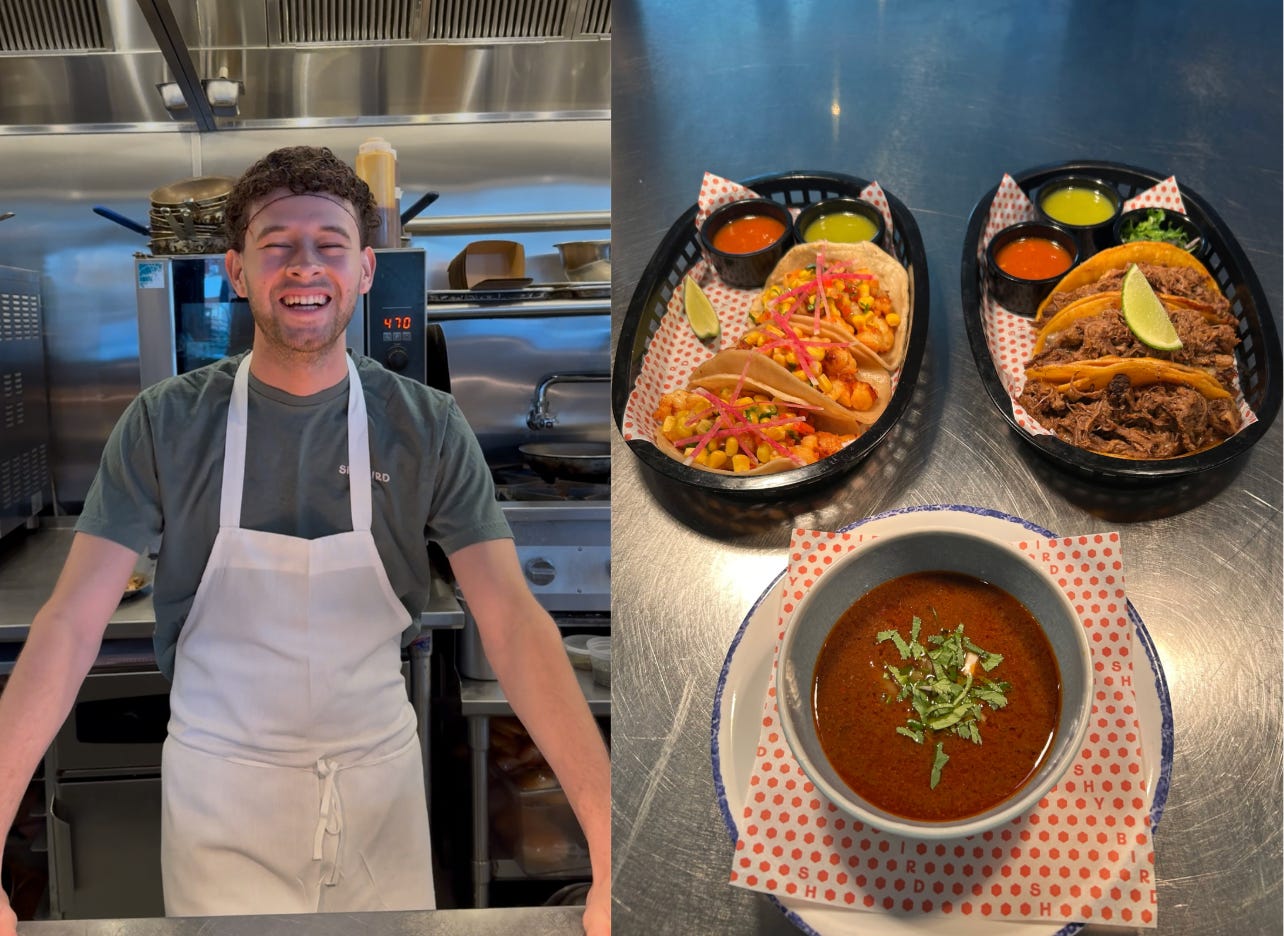
From Monday afternoon through Tuesday service, the team worked it together in one place instead of across separate apps and group texts. Chef AJ and Matt refined the plating a little with Samuel. Hannah created awareness, excitement and traffic from guests and our team.
And then, for a few hours, all that mattered was all that ever truly matters in a restaurant. The hospitality, the guest, the team, the food, the beverage. The birria, the dip, the shrimp tacos Sam and Rafa built. The margaritas poured to go with them. The patio full before seven. Servers selling a special they believed in that they knew stood for something more than the standard Taco Tuesday. That’s hospitality. No software did that, and no software should ever try to.
When the night was over, Colette did work that often gets missed. It assembled the full record: sales by hour, product mix, labor against projection, the shift notes, the channel dialogue. The night beat its sales plan by 10%, liquor sales were up 43% from the previous week and hourly labor cost came in under 15%, well below a normal Tuesday. We could see what worked and what to figure out for next time.
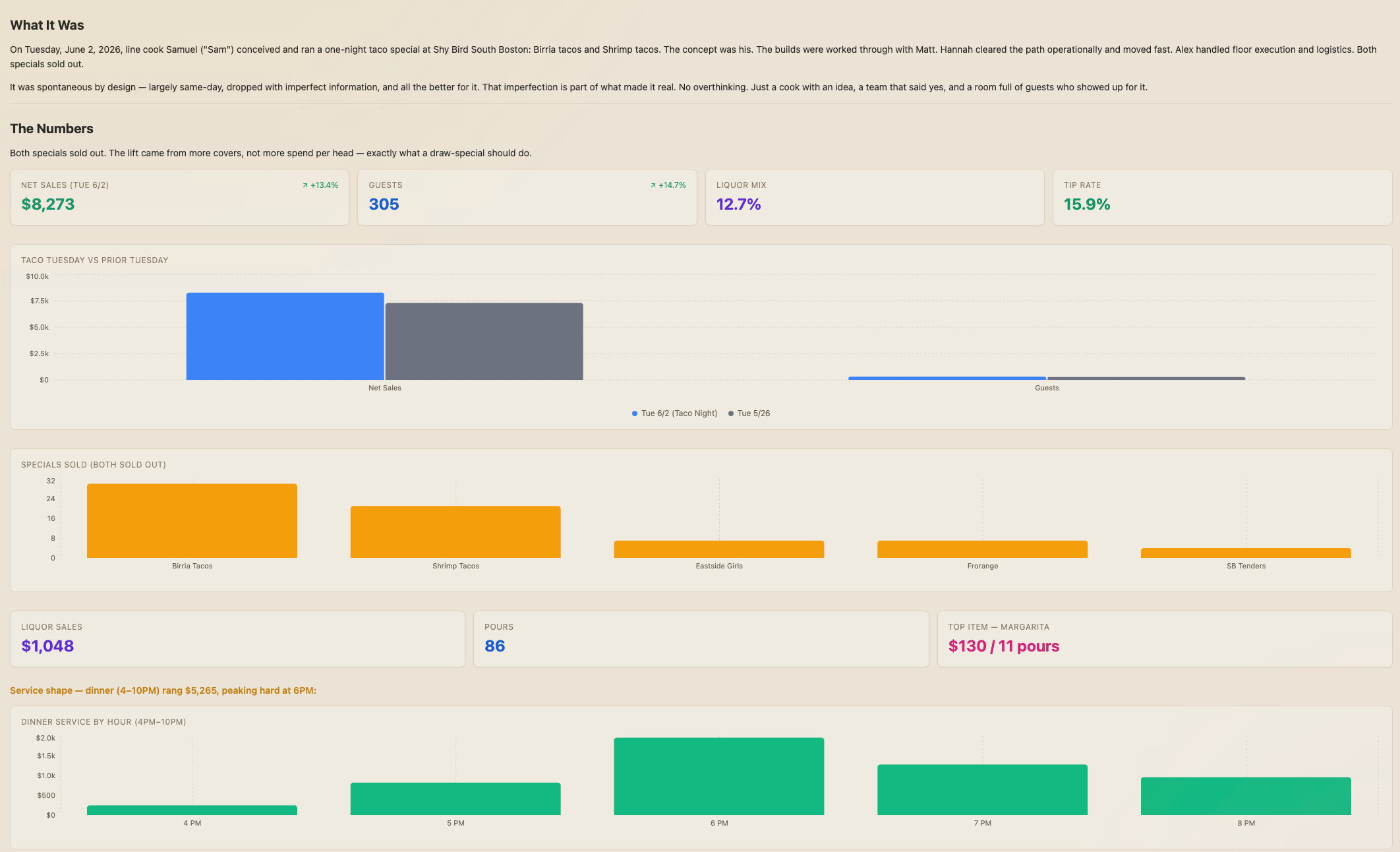
The record held the numbers and the narrative, the objective and the subjective. But this time the record is instantiated into digital memory in a way that does not fade over time or disappear with the natural ebbs and flows of restaurant staffing. Restaurants often run on goldfish memory, sloughing off one service to make room for the next. This one became institutional memory, a documented playbook for the next time a cook walks in with an idea.
In plain terms, here’s what Colette does.
Your team communicates and coordinates in one place. Shift logs, channel messages, operational decisions, all of it searchable, with memory, linked to what actually happened. If you’re reading this from an office job perspective think Slack + Dropbox + Asana + Airtable + Claude. The Monday conversation where Sam told me we were doing taco night tomorrow. The projection Matt pulled at 1pm. Alex’s note from closing. Institutional knowledge stops dissolving into a text chain or walking out the door with the last manager who left.
All your data, connected, eventually*. One conversation with your actual numbers instead of five dashboards you toggle between and reconcile by hand. Ask how last week’s food cost compared to target. Ask what drove the labor variance on Friday. Ask what the taco special produced, broken down by hour. Get an answer in seconds, grounded in your actual data, interpreted through the lens of how your restaurant operates, never an industry benchmark that doesn’t know what you are.
Automation that reduces stress and deepens engagement. It enhances operator judgment rather than replacing it, faster and better informed. The goal is a restaurant where the analytical burden gets absorbed quickly enough that operators learn from it instead of just surviving it. Where the feedback loop from a great Tuesday collapses from weeks of informal memory to a documented record that shapes every Tuesday after it.
There’s ambition beyond optimization here as well because if you double the profit of a 3% EBITDA business, that’s amazing but it’s still a 6% EBITDA business.
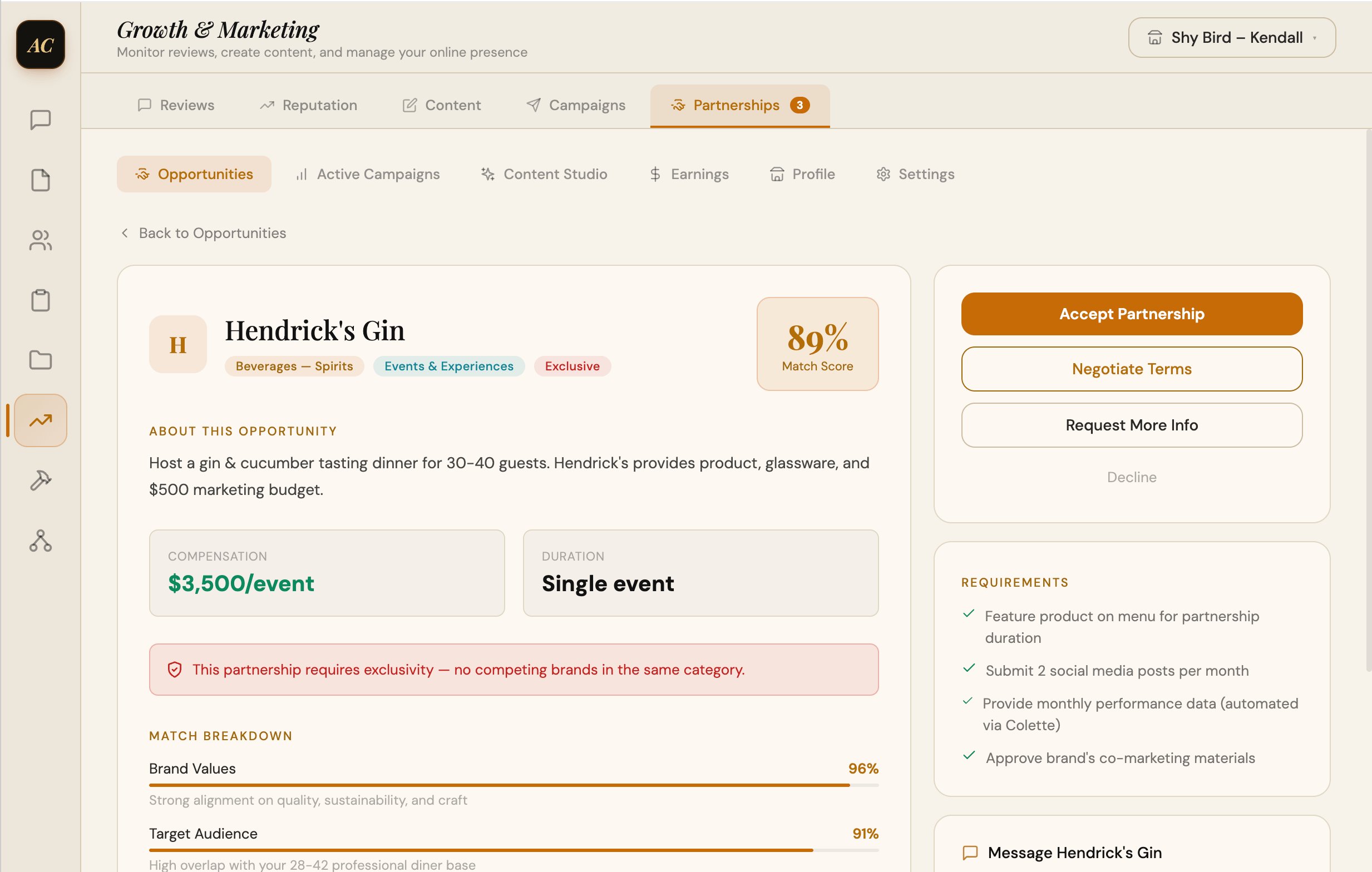
The infrastructure Colette is built on creates possibilities beyond daily operational optimization. Restaurants sharing and selling tools to one another, riding a wave of democratized digital building to keep high margin revenue in the restaurants rather than in a tech giant’s average revenue per user.
And restaurants taking their rightful place in the attention economy as community builders and influencers. CPG brands are aggressively chasing out-of-home food consumption because that’s where eating is increasingly happening. Restaurants are that channel. The majority of out-of-home food happens in restaurants, and brands like Heinz know it, which is why they’re investing aggressively in the channel. Restaurants should be capturing a share of that value. They just haven’t had the infrastructure to do it.
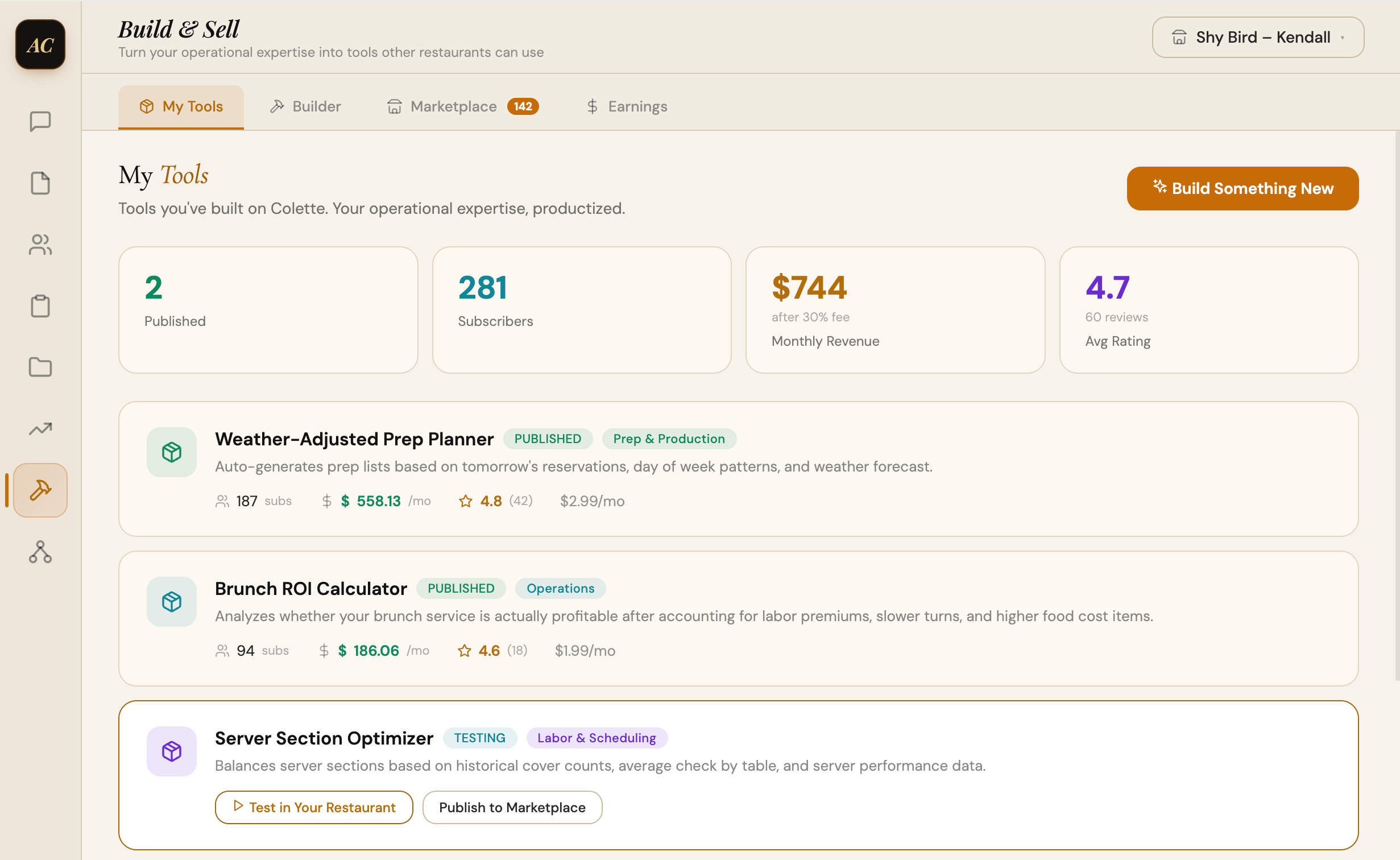
New infrastructure also unlocks new forms of cooperation. Collective buying power across aligned restaurants. Networks of independent operators will be able to aggregate their buying power efficiently for leverage with vendors. Many in our workforce travel across town to work two jobs for different employers. How might unaffiliated (shady, overtime dodging operators need not apply) restaurants in a neighborhood work together to better their businesses and the lives of their teams.
That’s not today. But the infrastructure is being laid now. The preconditions for revolutionizing the restaurant P&L are twofold: a restaurant that can impact its business at the pace the total perishability (food, seats, time) of the operation demands and a business that is more legible to the increasingly automated, agent-driven world that’s coming. We often ask ourselves this question at Colette:
‘How would the broader business world and economy interact differently with the industry if most restaurants had a solid mid-level data scientist, software engineer and financial analyst on staff for a fraction of the cost of a manager?’
That future is, in some ways, already here but, as the saying goes, not evenly distributed. We aim to address that with Colette.
We built Colette to focus the most important technology of our time on what we believe is the most important industry of our time. Restaurants will matter more in the world that’s coming, not less. They’ll carry more of the weight of employment, connection and sustenance in its many meanings. But only if we build the infrastructure that makes them more profitable and more human at once, as the same project, never competing priorities.
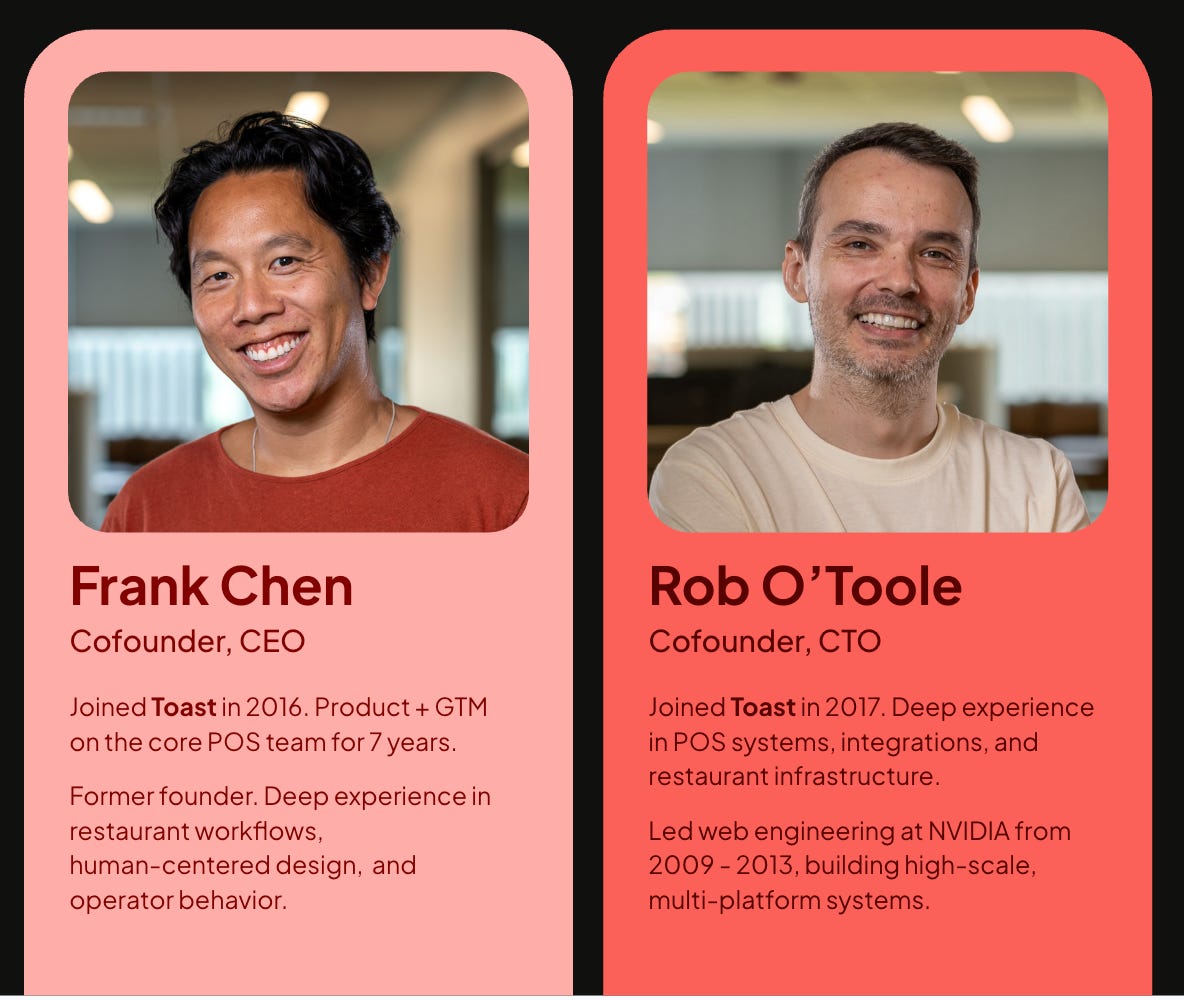
My co-founders in Colette are Frank Chen and Rob O’Toole, who spent a combined fourteen years at Toast building the infrastructure restaurants already depend on. We also built it with Shy Bird, Eberly & Central Machine Works in Austin, SRV in Boston, Docks in NYC. All operators with strong opinions and principles about team communication and culture. Not for nothing, also operators with the patience necessary to work with an early stage startup finding its way, a huge thank you to them. I’ve always believed true co-creation with restaurants is the best way to build restaurant tech and I think this even more true when building and iteration are so accelerated.
Colette is for every operator who knows their restaurant better than any software ever has. For every GM tired of data arriving too late, intuitions abandoned because the signal wasn’t there to support and a constant looking backward instead of forward. And for every Samuel who deserves a full room of guests enjoying killer birria broth.
Footnote:
*I say eventually because right now we have Toast, Square, Restaurant 365, Tripleseat, 7 Shifts and a few others. There is a very important conversation we all need to be having with tech providers to pressure them into a more open API system. APIs are how different softwares talk to each other and openness is critical in the AI era. If you are talking to any software service provider, demand to know their status on openness of APIs and ask for receipts because most reps might not actually know the right answers.